
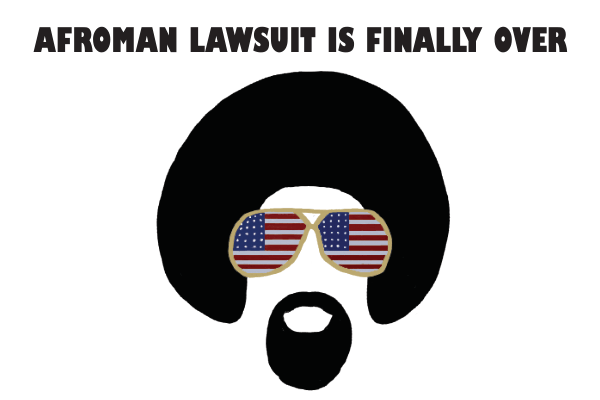























On March 18, 2026, rapper Afroman (Joseph Foreman) won a major lawsuit against a group of Adams County, Ohio Sheriff deputies who were attempting to sue him for millions, over using security footage of the 2022 raid on his home in music videos and merchandise, claiming invasion of privacy and defamation charges. This case sparked a broader debate over the limits of the First Amendment and how far public officials can go in shielding themselves from criticism.
Police Raid
On August 21, 2022, Adams County deputies raided Afroman’s Winchester, Ohio home. According to a Fox19 report, police obtained a warrant to search the residence based on “probable cause that drugs and drug paraphernalia were located on the property and that trafficking and kidnapping had taken place there.” However, the hours-long search produced no evidence supporting the claims by the confidential informant, including the alleged existence of a basement dungeon, partly because the house didn’t even have a basement.
Although Afroman wasn’t charged, the damage sustained to his home remained, reporting that the officers kicked in his front door, damaged his gate, cut the wiring on his security camera system, rummaged through his closet, flipped through his CD collection, and seized thousands in cash, of which $400 was initially missing upon return.
Afroman later attempted to file a lawsuit over the damage, but the case was dismissed because the officers acted under a valid warrant.
This incident prompted the questions: Do deputies have any expectation of privacy inside
someone else’s home while carrying out official duties? And if a lawful search turns up nothing, does that mean the warrant should have never been served? The jury’s response on the last point was no.
Music Videos
In response, Afroman chose not to pursue further legal action. He stated, “I asked myself, as a powerless Black man in America, what can I do? And the only thing I could come up with was make a funny rap song about them and make some money, use the money to pay for the damages, and move on.”
As a result, Afroman released the album Lemon Pound Cake in 2022. Containing tracks like “The Police Raid,” “Why You Disconnecting My Video Camera,” and “Will You Help Me Repair my Door.” Accompanying the parody music videos he included footage from the raid and satire commentary.
In response, several Adams County deputies: Shawn Cooley, Justin Cooley, Michael Estep, Shawn Grooms, Brian Newland, Randolph Walters, and Lisa Phillips filed a civil lawsuit against Afroman and his label, claiming “they had been ridiculed, embarrassed and threatened since the release of the videos.”
Lawsuit Claims
The deputies filed a lawsuit against him for defamation, invasion of privacy, false light, and commercial misappropriation of likeness. They claimed that Afroman used their images without permission and profited from their identities, and told lies about them that had caused them immense humiliation, ridicule, mental distress, embarrassment, loss of reputation, and even death threats. Afterward, Afroman said, “Me laughing at them, making songs about them, is more powerful than their authority.”
In response to the lawsuit, Afroman filed a counter suit, and The American Civil Liberties Union (ACLU) filed an amicus brief supporting him and calling the lawsuit a classic “Strategic Lawsuit Against Public Participation” (SLAPP) suit, describing it as a meritless attempt to silence criticism.
A judge dismissed six of the eight claims filed, keeping false light and defamation to proceed. Under Ohio law, defamation protects against false statements of fact that harm a person’s reputation, and for public figures, courts require proof of actual malice. While, false light requires the statement to be highly offensive to a reasonable person, focusing on misleading and offensive impressions.
A key defense for both defamation and false light is parody. If no reasonable person would take the statement as a literal claim of fact, it’s protected under law. Afroman argued that his music and videos were satirical and exaggerated, and that much of the footage used in the music videos is real and the events depicted actually occurred, then the resulting portrayal even if humiliating or critical isn’t necessarily false.
The local judges’ opinion on the matter differed, concluding that for purposes of false light, Afroman publicized false facts about the cops which would be highly offensive to a reasonable person. Furthermore, the court found that the defamation claims that police stole money, or had previously used drugs were the type of statements that would cause reputational harm.
Regardless, Afroman claimed the context of songs included parody and satire, which is generally protected by the First Amendment. Thus claiming that if the government kicks down your door, the constitution protects your right to say you don’t like it.
The Trial
Three and a half years after the raid, the case finally went to trial, with the deputies testifying about the humiliations and pain they claimed to have suffered.
One of the humiliations in question and the reason they were seeking nearly $4 million in damages was Deputy Shawn Cooley testifying that anonymous people had mailed multiple pound cakes to his workplace and were now referring to him as “Deputy Pound Cake,” which was tarnishing his reputation. However, he admitted to walking past the pound cake as fact.
Similarly, Sergeant Randy Walters testified about being insulted in one of Afroman’s songs called “Randy Walters is a Son of a B****” However, he admitted that terms like “son of a b****” were opinions that can’t be proved. He also cited a lyric suggesting that Afroman had slept with his wife, saying, “It has caused tremendous pain in my life.” Despite him saying the statement painted him in a false light, he conceded under questioning that he did not know whether the claim was true.
The defense called Afroman and Rhonda Grooms, the ex-wife of Shawn Grooms, one of the plaintiffs, who said that Shawn wasn’t devastated by his portrayal in the video and even laughed about it, contrary to his claims.
Nonetheless, Afroman took the stand and argued that the deputies themselves created the situation. As reported by WCPO, Afroman stated, “If they hadn’t wrongly raided my house, there would be no lawsuit, I would not know their names, they wouldn’t be on my home surveillance system, and there would be no songs.” Adding, “I got to the right to kick a can in my backyard, use my freedom of speech, turn my bad times into a good time.” He emphasized that his work was entertainment, not journalism, and that viewers were free to form their own interpretations. He subtly pointed out that the lawsuit was retaliation against him for exercising his First Amendment rights.
Freedom of Speech Rights Prevail
Ultimately, the jury found in favor of Afroman on all counts. The decision rested on the principle that his content: songs, videos, and satire would not be determined by a reasonable person as fact. This being the case because the deputies’ case relied on treating jokes and exaggeration as factual assertions. Therefore, their claims of defamation and false light failed.
The jury determined that Afroman’s use of the raid footage to be protected by free speech rather than wrongdoing. After the verdict and outside of the Ohio court Afroman declared, “I didn’t win, America won. America still has freedom of speech. It’s still for the people, by the people.”
