























Stanley Kubrick’s Barry Lyndon, under the candlelight, becomes even more damning in its study of ambition, identity, and fate. It is much more than a rags-to-riches story, but rather the history of illusion, luck, and self-deceit. Using detached and analytical style, psychological mirroring, parallel action, and a painting-like look that evokes masterpieces from the Renaissance to the 18th century, Kubrick has made human will at once extreme and impotent.
Redmond Barry’s (or Barry Lyndon’s) story isn’t about a hero; rather, it’s a story of deceiving others and also deceiving yourself. Kubrick removes the feeling of closeness and emotional investment that we expect from this single-character story; the film’s omniscient narrator finds pleasure in revealing events long before they occur, so there can be no suspense for us, but rather the comfort of being well-informed of all surprises in advance. There is a purely philosophical interpretation to this, and it is this perspective that will ultimately lead us to believe that the characters are not themselves determining the events and manipulating their destinies, but rather they are determined by outside forces (social strata, luck, human weaknesses) of which they are unaware. The narrator is cool, knowing, and even amused at the futility of Barry’s achievements, even as it reveals them to be of minimal importance.
Psychologically, Barry is essentially undefined, and his self-image is fluid. He starts as a romantic idealist, willing to duel a man over a woman in an action that seems more performative than earnest. Throughout his transformations, as soldier, deserter, spy, gambler, and finally aristocrat, Barry merely plays the roles with a certain detachment and readiness as the role may present itself. He doesn’t transform from his original “lover-boy” self but rather accumulates different identities and runs with them till it’s time for him to change again. Ultimately, he is tragic because he never really has a self with which to hold on to as life progresses, and we are left with a hollow man who can’t maintain his mask as we witness his loss and the utter lack of original being he possessed to begin with.
In reinforcing Lyndon’s tragedy, Kubrick’s mirroring techniques are applied with significant psychological effect. The fairly simulated, phoniness of the early duel, and Barry’s now dead and meaningful duel at the film’s end, show the futility of all he has been doing for over twenty years; Barry’s courtship of Jenny looks almost identical to Barry’s marriage with Lady Lyndon (but without love, merely social gain), his story line may seem like it is building up but instead is circling.
The idea of performance not only encompasses Barry and extends into his entire social context, in which existence for an aristocrat consists merely of being able to perform at the theatre of manners with the required action, the correct style of dress and manners in a rigid context; in this sense, for Barry to obtain this existence is not a victory but a perfection—he is ready to truly participate in the world of appearance and this gives rise to the idea of a “real” self when identity depends on what we can convince other people we are, in which there is none beneath the performance. I think Kubrick’s response is bleak: Barry is ultimately a failure, not because he can’t maintain his composure, but because of his inability to fully internalize the emotional emptiness required to survive in that world.
Kubrick’s conclusion becomes even sharper when placed against William Makepeace Thackeray’s book, “The Luck of Barry Lyndon,” whose very title frames Barry’s rise as something almost accidental, rather than earned. In Barry Lyndon, this idea is stripped of any lingering romance: if Barry’s ascent is governed by luck, then his failure is not a dramatic fall from greatness but an inevitability built into a life sustained by performance alone. What makes him tragic is not simply that he cannot hold onto status, but that he never fully becomes the kind of person that the world requires; someone capable of suppressing genuine feeling in favor of pure calculation and social instinct. He imitates the gestures of aristocracy but resists, however faintly, its emotional void, clinging to impulses (love, pride, sentimentality) that the system punishes. In that sense, luck grants him entry but not transformation; it places him in a role he can mimic but never inhabit. Kubrick seems to suggest that survival in such a world demands not just deception of others but a complete erasure of the self, and Barry’s ultimate “failure” lies in his inability—or perhaps unwillingness—to carry that erasure to its logical end.
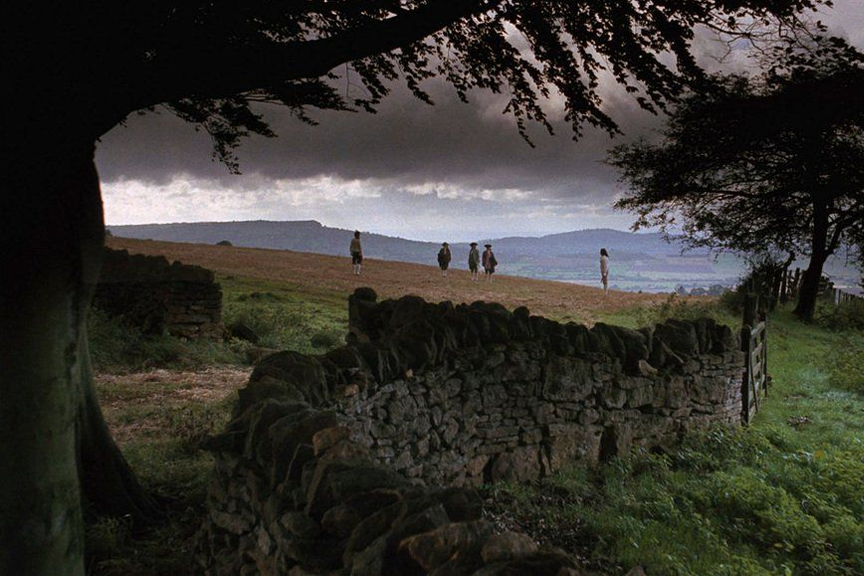
Visually, painting-and more specifically, 18th-century portrait painting-frames Barry Lyndon’s entire philosophical conception. In his trademark style, Kubrick used naturalistic light to reproduce old art from the Renaissance-18th-century, with precisely composed mise en place practically static scenes, like still lifes where form and texture seem to be valued more than action; his images are so beautiful in their formality that they freeze individuals in time in such a way as to detach the viewer and not allow any sort of emotional empathy with or investment in these characters. Barry Lyndon does not draw the audience into his life and let us experience his life, but rather lets us stand back as we would at a painting and view him.
The painterly aesthetic of Barry Lyndon ultimately brings its philosophy to its hushed but crushing conclusions. By stripping Barry’s life to a string of carefully constructed, still images, the film seems to represent life as something gradual, observed and detached; each frame seemingly whole in itself, but separate from those around it, reinforcing the idea that life, like the class system Barry wishes to belong to, is simply a construct of surface rather than substance. This cold objectivity is heightened by the film’s languid and uncaring pacing; rather than being compelled to identify with Barry’s ups and downs, we are positioned as observers, given the distance to ponder his progression, and the nothingness at the center of it. In the end, Stanley Kubrick reduces Barry’s journey to something far colder than tragedy or triumph: a life shaped by illusion, sustained by performance, and emptied of lasting meaning. All that remains is the recognition that ambition, identity, and status collapse into the same quiet silence that once was.